
The Second Cipher War, Part 1: 2374 to 2375
The Interstellar Age, S03E08

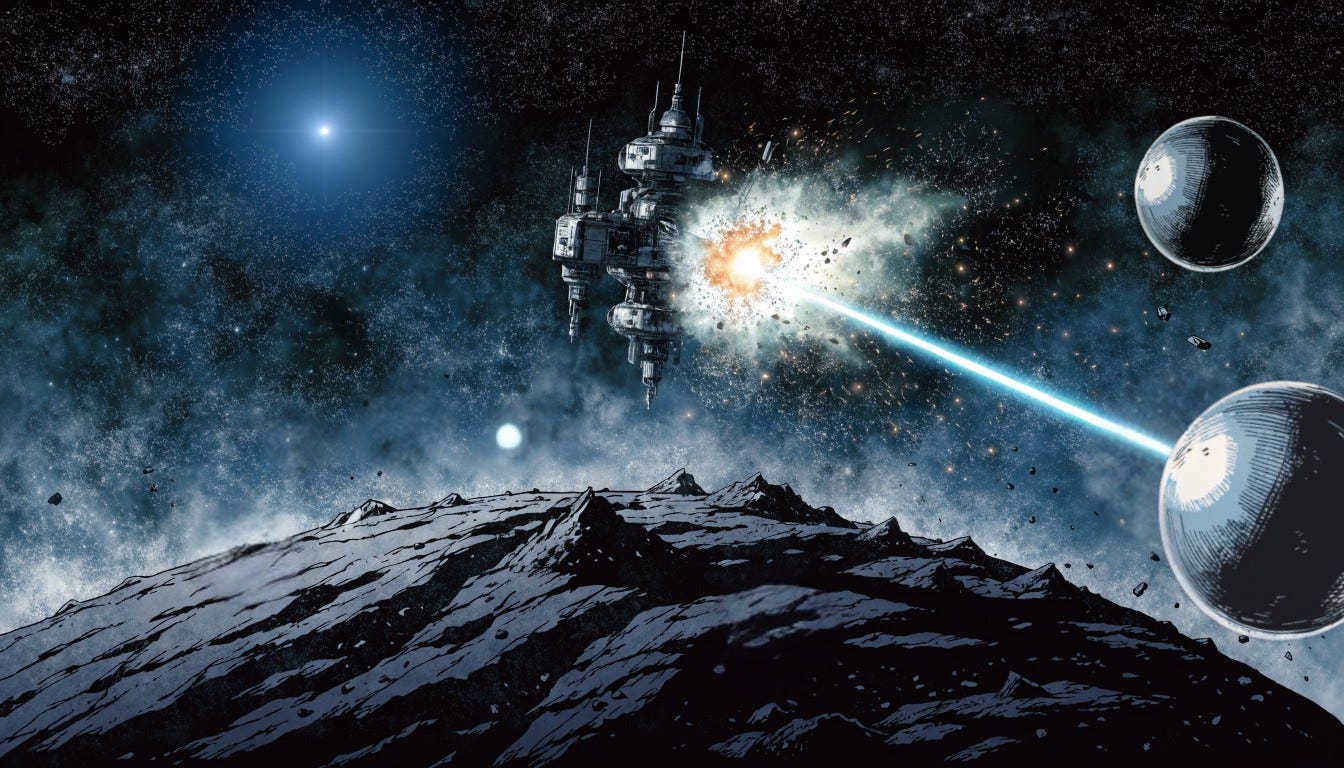
The first targets struck during the Second Cipher War were unmanned: the stealth platforms which had been observing Byas, Ranak, and Embra for the past twenty years.
Up to that point, Allied Joint Command (AJC) had assumed that the platforms had gone undetected. Yet immediately following the failure of Operation Signet Arrow, all three were destroyed. How soon after was difficult to determine; days, possibly hours, though how the Ciphers on-scene could have received word of the operation so quickly was not clear. In any case, this could only mean that the Ciphers had been aware of the locations of these platforms for some time, despite no mention having been made of them during negotiations with Dr. Toll.
But this was only discovered after automated missions were dispatched to investigate when the platforms failed to check in on their regular schedule. By the time these recon drones returned with the data, AJC had bigger things to worry about.
An invasion of the Allied powers began in early November, 2374. Cipher fleets attacked Perun in the TIU, Hampton in the FWR, Rapport in the UCC, and a number of outposts, including the joint station at Anson Point. Allied defense squadrons in each of these systems were easily swept aside or destroyed. Despite AJC’s full mobilization, most Allied space assets had been concentrated into three major fleets; the fear was that, as in the first war, the Ciphers would strike directly at the most strategically vital systems with overwhelming force, ignoring border systems and outposts. Those three systems were Hyperion, where the TIU’s primary military shipbuilding was still concentrated; Ouroboros, which despite diversification remained the single largest source of antimatter for the Alliance; and Frontier, both the FWR capital and their largest shipbuilding center. Earth and Unity Prime were also given larger defense squadrons, despite their lower strategic priority.
The Cipher attacks against border systems and smaller, more recently founded colonies was a surprise. The largest target struck, Perun, had only been founded in 2354, and had a population of around fifty thousand. Equally surprising was what the Ciphers did after defeating Allied space forces in these systems: nothing. No bombardments, no ground invasions. They simply sat in orbit, menacing.
AJC was split on how to respond. Many younger commanders favored a counteroffensive to retake either Perun or Anson Point, the two most strategically valuable of the occupied systems. Others advocated caution; there were only a handful of veterans of the Corporate Worlds War (2311 - 2314) left in service, even at the highest levels of command. Despite human lifespans now regularly reaching 125-150 years, generals and admirals in their 80’s or 90’s were a rarity. But one of these was, since the death of Rance Wolfe, the galaxy’s most famous living sailor.
Fleet Admiral Amarissa Chen, aged 96, was then TIU Chief of Defense Staff, a position she’d held for nearly thirty years. She had never held a field command, but she had worked closely with Admiral Wolfe in planning the battles of Hyperion and Ouroboros, and the offensive into the Corporate Worlds in 2314. Now, she suspected a trap. There seemed no reason for the Ciphers to seize these systems and stop, rather than either landing to take control, or destroying anything vital and moving on.
Chen’s explanation was simple: the machines were trying to draw the Allies into battle. In that case, it would be foolish to give them what they wanted, absent an ace in the hole. Chen’s preference was to launch probing attacks, smaller scale raids against the known Cipher systems, ideally two or more simultaneously. This would have the dual effect of testing Cipher defenses and quieting domestic calls for action without overcommitting.
The more aggressive members of the council seized on this alternate plan, but pushed it further—advocating a full scale attack against Sukat to destroy the Ciphers there. But Chen argued against sending such a large force away when the total strength of the Cipher fleet was unknown, and the strategic importance of Sukat to the Ciphers was unclear.
In the end, Chen’s plan won out. Embra and Ranak were chosen as targets; being more heavily developed than Byas, they might have more strategic value, while being less heavily defended than Sukat. The raids were launched in January, 2375. After the poor results of inter-allied cooperation during Signet Arrow, each raid was assigned to a different fleet; the FWN took Embra, the TDF Ranak.
Given the clandestine nature of their presence in Ranak, it was perhaps unsurprising that Cipher assets there were minimal. Upgrades to stealth and detection systems made after Signet Arrow proved effective, allowing the TDF to locate the Cipher ships loitering in the outer system and destroy them. A few other Ciphers responded to these ambushes, and with the advantage of numbers, these too were easily dispatched.
But given the fact that the ranakeen were only barely aware of the Ciphers’ existence, the victorious Terrans were left with little to destroy after defeating the few Cipher ships they found in-system. Bombarding the undersea bases from orbit carried too great a risk of harming or alerting the natives, so once the handful of stealthed outer system bases were located and destroyed, the TDF could do little but wait for a Cipher response. When none came, they retreated.
It was a different story at Embra. The Cipher presence there was much larger, and not only were the embrites aware of their existence, they were apparently committed to their worship. But even here, the FWN scored a surprisingly easy victory. The Free Worlds’ new UREB cruisers proved their worth, inflicting heavy losses on the Ciphers while conventionally armed ships kept them tied up. After the victory in space, a number of Cipher-built industrial sites on the planet were identified and destroyed, along with similar orbital installations.
These twin successes triggered a brief wave of elation throughout the Alliance. Perhaps the Ciphers had not advanced as much as humanity had in the decades since the war; perhaps their early successes were only the fruit of surprise and Allied disorganization. Now, the Ciphers might make a mistake, overreact to the raids, open themselves up to a more strategic defeat.
Again, they did nothing. Two weeks passed after the raid with no response—no change in disposition, no further attacks. All the while, the Allied systems attacked in the initial wave remained under the machines’ strange, silent watch. While the machines had still made no aggressive moves against these outposts, their very presence was dangerous.
All the occupied planets and stations had the latest in water recycling and food processing systems. But these would not last forever; all of them, including the colony on Perun, required regular resupply of critical materials and resources to keep them running. Perun could survive for up to a year, but several of the posts—including the critical Anson Point—had been due for resupply before the invasion.
There were just over a thousand people at Anson Point, and two months after the invasion they were on severe rationing. The mixed civilian/military garrison would not last more than a few more weeks before starvation and dehydration started to take their toll. Besides the humanitarian concern, the system would be a vital staging ground for any future operations in or around Sukat.
The success of the raids emboldened the Allies, and AJC decided that something had to be done to save the station—all except Admiral Chen, who if anything seemed more dubious after the easy wins. But the tide was irresistible this time; even Chen could see that if the Ciphers refused to act, the allies would have to.
With her objections reluctantly dropped, a large-scale operation to liberate Anson Point was planned. Forces would be drawn from numerous groupings across the Alliance to reduce the burden, and hopefully mask the buildup from the enemy. The fleet included about an equal number of UCC and TDF ships, with a supporting FWN squadron. The Terrans and Free Worlders were reluctant to include the United Citizens’ Defence Forces (UCDF) in the operation, given their lack of experience—and perceived lack of commitment due to the pacifist leanings of the Citizen population. But Anson Point was a joint Terran/UCC facility, and the current leadership on the Councils were anxious to prove their value to the Alliance.
The plan called for a three wave attack. The TDF would strike first, engaging the Ciphers known to be in the system already, and assuming a trap. Once the trap was sprung, the UCDF would swoop in to engage the ambushers, with the FWN squadron held in reserve to exploit success or cover a retreat if necessary.
The attack was launched in mid-February. The Ciphers had positioned themselves in three main groupings of a few dozen ships each, orbiting the planetoid on regular paths at regular intervals. Predictable—the same behavior they had once displayed at Ouroboros and the Machine World, and more recently at Ranak and Embra.
The first TDF wave jumped in directly on top of each of these groupings, inflicting heavy losses in the first volley. Within minutes, another wave of Ciphers decelerated from Stardrive close-in on the Terrans, striking with their UREB cannons and destroying several ships, as expected. Then, like clockwork, the UCDF jumped in upon them. The Terrans, turning into the attack, caught the enemy in a vise.
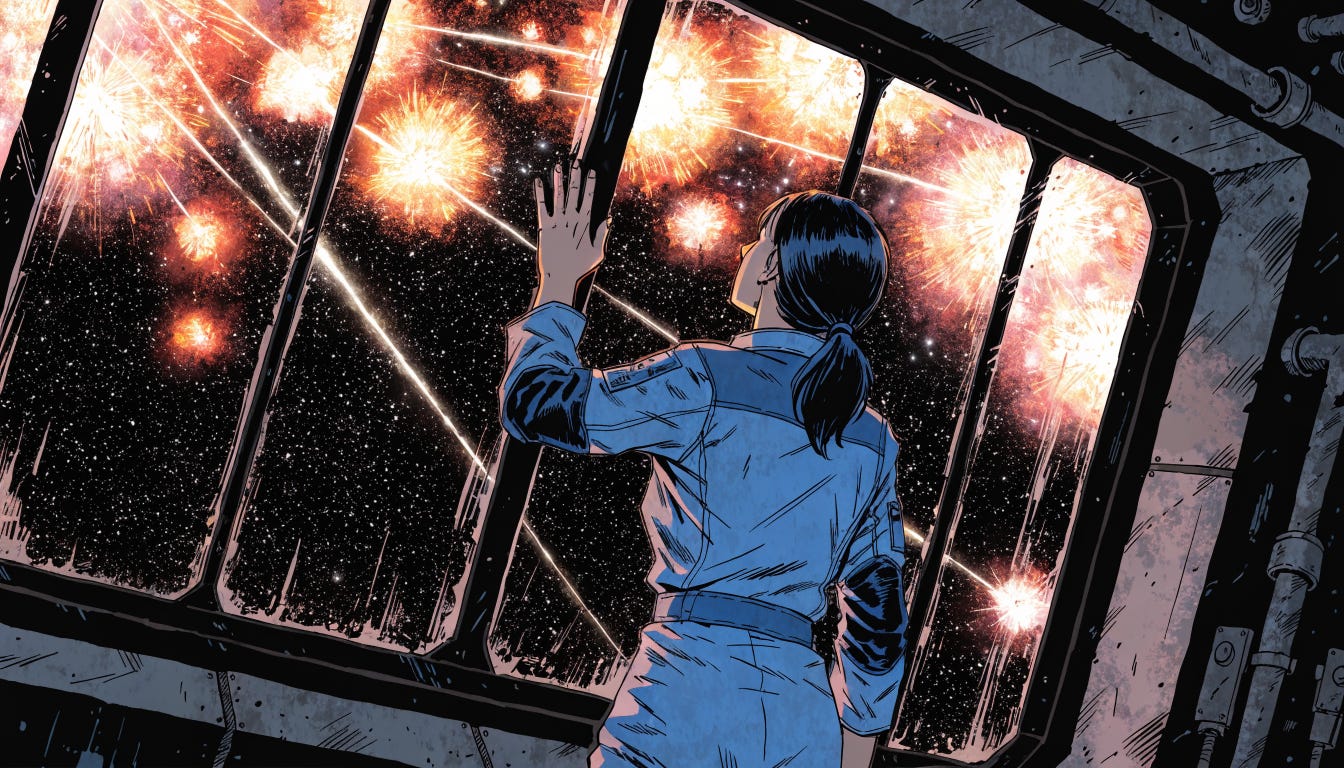
Just as victory seemed certain, everything fell apart. Dozens of Cipher ships suddenly appeared all around the engaged fleets. Their first volley was utterly devastating, destroying or crippling fully half the Allied ships engaged. These Ciphers had clearly taken time to line up their shots before engaging—meaning they had been operating at stealth right under the Allies’ noses.
Despite most being outside the minimal gravitic threshold of the planetoid, the surviving Allied ships were too closely engaged to risk Stardriving away. They quickly rallied by squadron and tried to fight their way out of the ambush, signaling for assistance with the few messenger drones they could get through. Despite the odds, the FWN reserve squadron jumped in at once, then moved in to engage the Ciphers at close range.
The Free Worlds commander, Commodore Warren Savage, split his small force in two, each formed around two UREB cruisers and striking at a different portion of the outer Cipher formation. The fierceness of Savage’s attack succeeded in creating brief openings through which some of the pinned TDF and UCDF ships were able to escape. Of around one hundred and twenty Allied ships engaged, only thirty-six were able to withdraw, and most of these were damaged. The rest were either destroyed or captured, including Savage’s flagship, the New Columbia, and the UCDF flagship Revolution, along with most of the UCC fleet.
After the Allies withdrew, the Ciphers finally descended on the Anson Point facilities. Recon data from leave-behind stealth drones showed them removing the personnel before destroying the facilities from orbit, then departing, their mission apparently accomplished.
This was not a crippling defeat for the Alliance, but it was a serious one. Aside from the morale shock, the greatest cause for concern was the Ciphers’ newly demonstrated stealth capabilities. After the Sukat Incident, AJC had studied the data from both the initial ambush and Signet Arrow. Modifications had seemed successful, penetrating Cipher stealth during the raids on Embra and Ranak.
Now, it appeared the Ciphers had either adapted to these changes, or had once again been hiding the true extent of their capabilities. The Cipher stealth employed to such devastating effect at Anson Point used broad spectrum masking and interference techniques, sophisticated visual camouflage, near-perfect heat recycling, radiation diffusion, and low-level EM and quantum interference. Only charging and firing their UREBs produced enough energy to break through this stealth screen. By then it was too late.
But if the defeat was embarrassing and concerning for the Terrans and Free Worlders, it was a complete disaster for the UCC. The Councils had never been much of a military power to begin with. Now, with the best part of their fleet lost in a defeat which achieved nothing, in defense of an outpost most Citizens hadn’t wanted in the first place, already shaky public support for the military and the war was severely battered. And it was about to take another, fatal blow.
The planet Zevka was one of the original five corporate colonies, founded largely by Turkish settlers operating under contract from Surya Offworld in 2339. The planet was originally named Anlaşma (Turkish for deal/agreement). Always a hotbed of social activism, Anlaşma was the first world after Venture to revolt against the OIGC during the 2314 revolution. After the war, the world’s Council changed its name to Zevka, derived from the Turkish word for “delight,” for the planet’s famously beautiful climate and terrain. As a world, it remained one of the most fervently committed to the ideals of the UCC—except, ironically, for one of the core ideals: pacifism.
While hardly a unitary bloc on this or any issue, opinion among Zevkans was broadly more supportive of the military than on other worlds. Most favored using UCC strength to defend UCC ideals; Zevkans had broadly favored a harder line against the FWR after the Tannhauser Incident. Now, Zevka’s Citizen’s Council was the only one in the Union calling for an immediate increase in military spending following the defeat at Anson’s Point. The rest were either hesitating to make any pronouncement, or calling for unilateral disarmament.
Perhaps this was why the Ciphers chose Zevka as the target of their next offensive. When they arrived in early March, the system’s minimal defenses were easily routed, leaving the Ciphers unopposed in space. Unlike after their previous attacks, they did not simply wait for an Allied response. Cipher platforms began descending to the surface within hours of the battle and abducting people, seemingly at random.
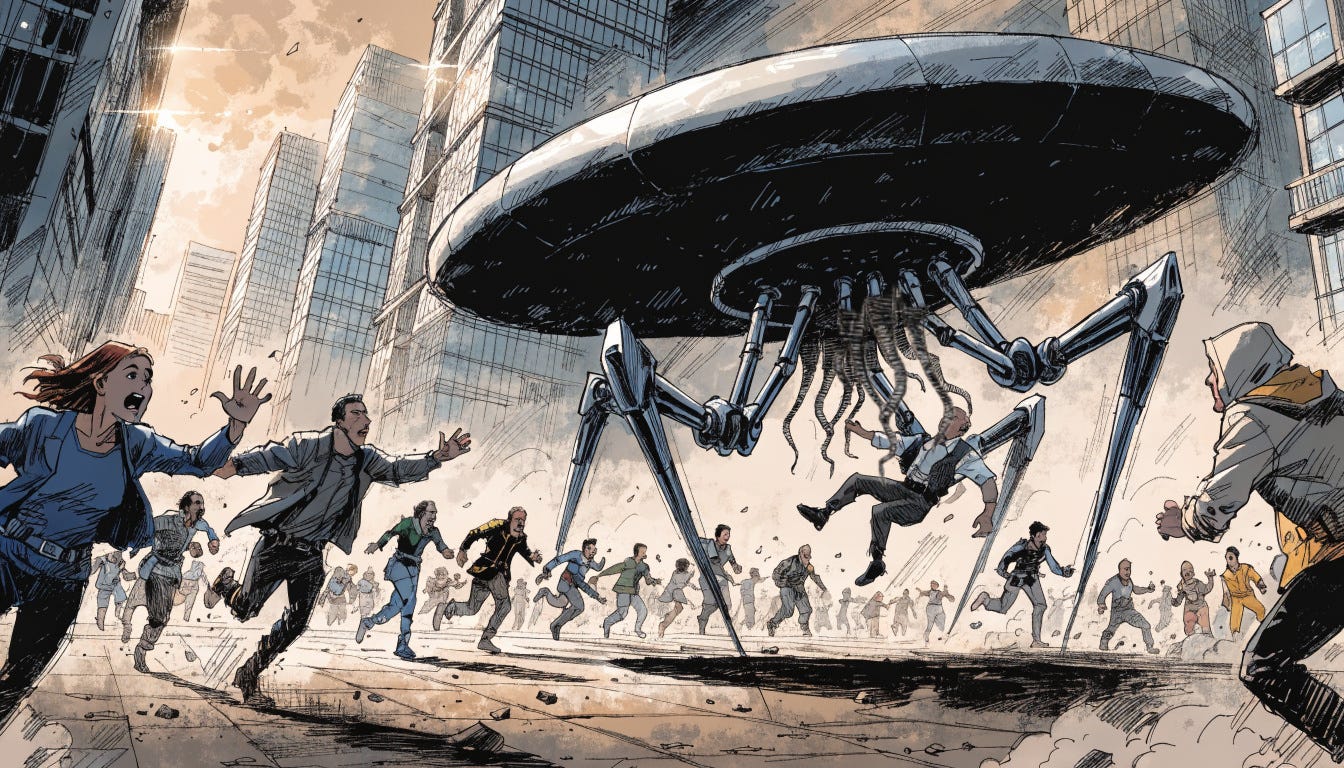
Citizens lived in fear of the descent of the strange craft, which they were powerless to stop—spherical ships hovered silently to the surface, their smooth single-piece hulls opening, articulated arms or metallic tentacles emerging to draw captives in. Ground platforms were also seen for the first time since Signet Arrow: smaller, floating ovoids with masses of metal tentacles, and large quadro or hexapod walkers with disk shaped heads, which could pursue fleeing captives, and killed anyone who attempted to stop them. No-one knew where the captives were being taken, or what was being done to them—only that none returned.
The nightmare of the occupation created a new crisis in the Alliance. The UCC was split on how to respond; some Councils wanted to appeal to the Allies to launch a counterattack and liberate the planet as soon as possible. Others wanted to open negotiations with the Ciphers in the hopes a peace treaty might free Zevka, despite the fact that no contact of any kind had been made with the Ciphers since Signet Arrow.
The AJC favored the military option. Despite the defeat at Anson Point, most high commanders, including Admiral Chen, believed that the issues the defeat had exposed could be corrected for. Already, new methods for penetrating Cipher stealth were being tested; while these were still under development, doctrinal and tactical changes were being disseminated to avoid such a devastating ambush from being effected again. These included avoiding close-in engagement with known Cipher forces, and employing more small ships and drones as screening forces around fleets. The TDF were also scrambling to build UREB platforms, given the demonstrated success of the weapon at Sukat and Anson Point.
Admiral Chen and most of the AJC favored waiting a few months until some of these doctrinal and technological changes could mature. But as the occupation and its horrors went on, political pressure mounted, from both sides of the debate. Hawks wanted immediate action to retain the initiative; doves wanted to stop the fighting and do whatever it took to make a deal with the Ciphers. More and more lower-level Councils in the UCC were voting to withdraw from the Alliance entirely and make a separate peace.
The governments of all three major human powers put increasing pressure on the AJC to do something. Finally, Admiral Chen and the AJC relented. An offensive was planned for May, 2375, just over six weeks after the invasion. The plan of attack was far less bold than that at Anson Point; a combined Allied fleet, with the largest contingent provided this time by the FWN, would jump in well outside Zevka’s gravity well and open fire at medium range. The goal was to either draw the Ciphers in to attack, or drive them off with a show of superior numbers and firepower.
In any case, the fleet would remain at range as long as possible, withholding its strength in close-range combat in case an ambush should be sprung. If the Ciphers attempted to use the planet as a shield—either by hiding behind it, or firing from in front of it—the fleet would break into squadrons and maneuver for better shots while remaining in supporting distance in case of ambush.
The deployment plans were made, new methods were ready to field-test, and proven weapons and captains were prepared to fight. Yet once again, the machines were prepared to put the best laid plans of men to waste. And this time, the results would be more disastrous than anyone imagined.
By May, 2375, the population of Zevka was just over 100 million—most of whom had spent the last seven weeks living in fear of the faceless machines in their skies, their frequent and random descents to the surface to abduct them, children torn from the arms of their parents, whole families disappeared in the night.
But as some looked up into the night sky on May 12th, they would have seen distant flashes of battle amongst the stars. That might have made them hope that their deliverance was at hand. They could not have known what fresh hell was in store for them, how suddenly and cruelly those hopes would be dashed.
The battle at first seemed to go well for the Allies. After the opening volley, the Ciphers seemed content to exchange fire at long range. The Allied fleet had the advantage of numbers, while the Ciphers had an advantage in UREBs; but the more fragile Cipher platforms had the worst of this engagement.
Less than fifteen minutes into the battle, the expected stealth ambush was launched. But the Allied adaptations to the tactic proved effective; some of the stealth platforms were detected and destroyed before they could attack, while the rest were forced to engage the dense picket force of light craft and drones deployed in a wide bubble around the fleet before they could open fire on the capital ships.
The fighting was heavy, but the Ciphers appeared to have underestimated the scale of the Allied response this time. Even after the ambush, the machines were too few to overcome the powerful Allied fleet. Less than an hour into the fight, it seemed the Allies were headed for their first major victory of the war.
Then, the Cipher ships nearest to the planet abruptly ceased firing on the Allied fleet. Any hopes this might have been a prelude to a retreat were belied when the machines turned their guns on a new target: Zevka.
An ultrarelativistic particle beam is a devastating weapon when fired at a target in space. Even older-model UREBs cause immense kinetic and thermal damage; glancing hits release a flood of deadly braking radiation, often killing or disabling the crews of struck vessels. Only the heaviest armored and most durable modern warships, such as the Compact’s Titan-class battlecarriers, are able absorb even a single direct hit without shattering. No late-24th century vessels could survive even one.
But until May 12, 2375, such a weapon had never been fired at a target on the ground. At least, not before human eyes.
During the Massacre of Rāma in 2313, the Ciphers—then refraining from using their more advanced technology—had resorted to kinetic and nuclear bombardment to destroy the colony and about half its population. Many of the remainder died of radiation poisoning and wounds in the aftermath, but many more lived to be evacuated from the planet when it was liberated eight months later. Some would even return, when the radiation was cleared and the colony refounded the next decade.
Now, the Ciphers let loose with the full force of their deadliest weaponry. Cipher UREB shots obliterated cities, leveled mountains, vaporized seas. Those citizens who were not instantly atomized or burned to a crisp were bathed in lethal radiation, dying in a few scant minutes of indescribable agony, before their corpses, too, were reduced to ash and glass.
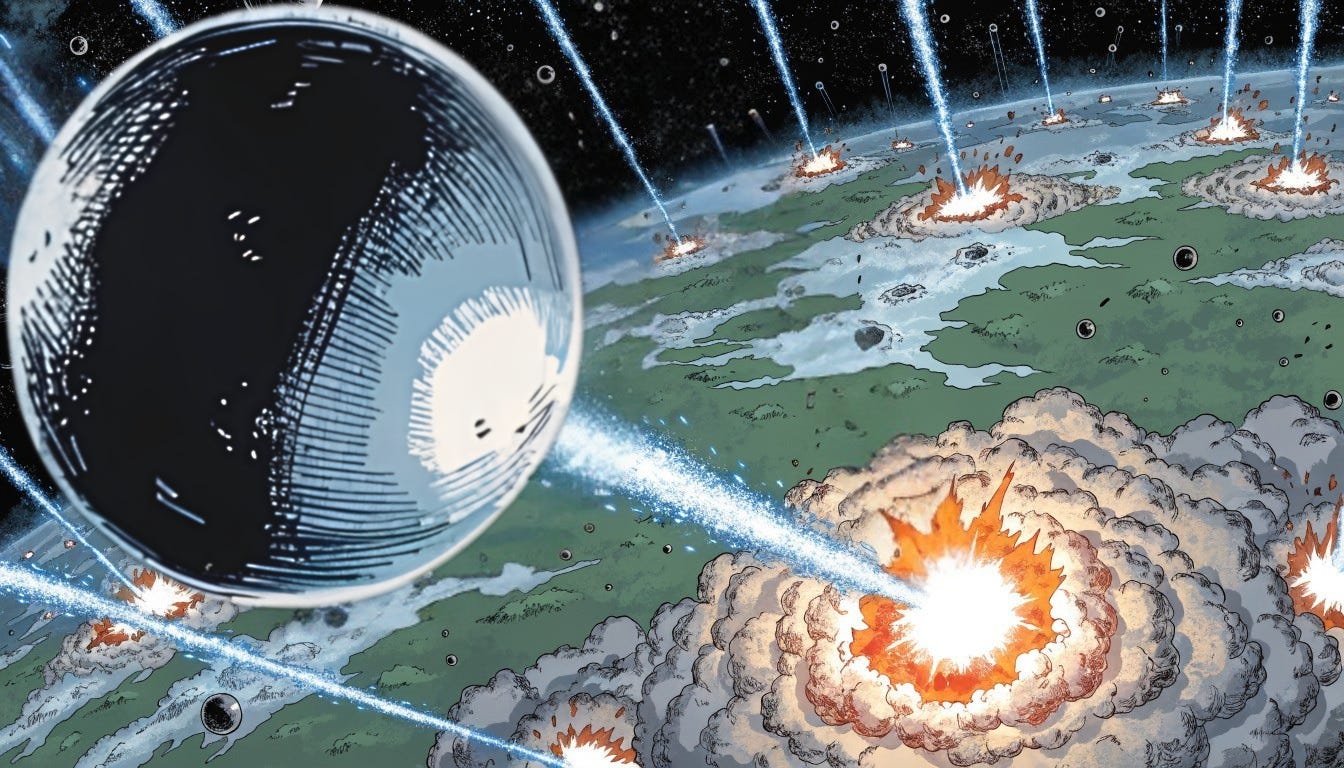
The Allied commander, FWN Admiral Collins, ordered his long range weapons to concentrate all fire on the ships targeting the planet. Nearly all of these Cipher platforms were destroyed—but it was too late. The annihilation of the planet’s surface took less than half an hour. Not one of the hundred million Zevkans survived the bombardment—except, perhaps, those the Ciphers had abducted during their occupation. Though whether this was a mercy was doubtful.
When it was over, the few remaining Ciphers retreated. The outposts and stations spread throughout the system had been destroyed by the machines long before, after their crews and populations were removed. The Allied fleet remained on station over the planet, desperately searching for survivors. Finding none, Admiral Collins decided to withdraw the bulk of the fleet, leaving a small squadron behind to monitor the ruined world. The rest returned to their staging point at Hyperion.
Outrage and terror spread like a wave across the Alliance. The death toll was dreadful enough—greater as it was than the entire butcher’s bill of the Corporate Worlds War. But it was the speed and ease with which the devastation had been accomplished that fueled the panic. A small number of Cipher ships had executed the apocalypse in mere minutes, while under fire, in a battle they were losing. If they could do that, how could the Alliance protect any planet? UREB shots could not be intercepted, nor blocked in any way. Even with a massive fleet in orbit, it would be impossible to stop stealth-equipped Cipher ships from getting close enough to fire on a world. Even a handful of hits could inflict millions of casualties; on higher population worlds like Earth and Eos, they might kill billions before they were stopped.
Reactions across Allied governments and populations were equally fervent and varied. Hawks wanted an immediate counterstrike-in-kind, destroying Sukat by UREB bombardment to show that humanity could give as good as we got. But the AJC argued strenuously against this plan, for the same reason they’d offered earlier; Sukat was not the home base of the Ciphers. The Alliance did not know where any strategically vital Cipher worlds might be located, while the Ciphers knew where to find the human capital worlds and homeworld. In a mutually assured destruction scenario, the Ciphers would inevitably win.
Public opinion in the UCC, meanwhile, shifted dramatically against the Alliance and in favor of making a separate peace with the Ciphers. Despite the machines having committed the massacre, most Citizens blamed the Alliance—more specifically, the FWR. Pacifist leaders argued that the massacre only happened because the Allied fleet had attacked; if they had kept out of it, as the pacifists had advocated, the Ciphers would eventually have left, or made contact to negotiate peace. “Zevka’s ashes are on YOUR hands,” read one of the movement’s best-known slogans. Broadcast images and flags waved at protests featured the phrase alongside images of the Republic’s President Hwangbo, Admiral Collins, and Admiral Chen.
Consensus on the AJC, and between President Hwangbo and Terran PM Nazari, was that neither negotiation nor surrender were an option. There had still been no contact from the Ciphers, no offers, no threats. Unless or until that changed, the strategic defensive must be strengthened; Allied economies must be put on a total war footing, pouring everything they had into shipbuilding and space-based weapons. Assets would have to be spread across Allied space to protect as many planets as possible. An unopposed Cipher UREB attack on any world with a significant population might shatter the Alliance. This status quo would have to be maintained until an advantage could be gained over the enemy—either technological, such as a defense against UREBs, or strategic, such as the location of another Machine World or base of operations.
But the UCC’s significant economic and industrial capacity would be essential for the massive scale of production required—to say nothing of the strategic disaster that a separate peace between the Citizens and the machines would entail. That meant that the UCC must at all costs be kept in the Alliance, despite prevailing opinion in most of the Free Worlds that they were dead weight who should be cut loose. Something would have to be done to placate the Citizenry, starting with assigning blame for the debacle at Zevka.
That proved the easy part. The venerable Admiral Chen offered to accept responsibility for the disaster and resign. As effective head of the AJC, this was fair enough; and on a personal level, Chen did blame herself for allowing the operation to go ahead when she knew it was not ready. Combined with her age and notoriety, that made her the ideal sacrifice. It was a final act of service to cap off a long and distinguished career, though it would be decades before her reputation was rehabilitated.
The AJC also offered to devote additional protection to UCC worlds. But while this placated the current government, Citizen opinion was vehemently opposed, fearing that increased fleet presence would only invite Cipher attacks. Instead, the AJC had to agree to largely demilitarize UCC worlds. Meanwhile, increased UCC industrial production would be devoted exclusively to non-lethals: defenses, medical equipment, civilian shipping, and so on. This would free up Terran, Free Worlder, and virgonid industrial capacity to build ships and weapons.
On the domestic front, the Councils had to agree to hold a constitutional convention as soon as the war ended, to settle the question of enshrining pacifism as a central legal foundation of the union going forward. Those measures combined served to settle the storm, at least enough to keep the UCC in the Alliance for now.
Shortly after Zevka, the Cipher offensive resumed. AJC had assumed that now, the machines would strike at the centers of Allied gravity while they were still weakened from losses at Anson Point, and politically divided due to the crisis over Zevka. Instead, the Ciphers once again adopted an incremental and peripheral strategy, attacking small outposts one or two at a time, with significant intervals between.
Several possible explanations for this were put forward. As machines, the Ciphers might be far more patient than an organic adversary, content to grind their enemy down over years, decades if necessary. Or, the Ciphers might have no interest in conquering the Alliance at all; their goals might be more limited in scope—though what those might be, none could say. Or perhaps, as pacifists in the UCC suggested, the Ciphers had never wanted war. Perhaps they had only been forced into their violent actions by human aggression, with the abductions being merely a clumsy attempt to learn more about us as Dr. Toll had suggested.
In any case, the machines were still silent, still attacking. The war would continue. But how precisely it should be fought, let alone won, was another question.
The answer would come in the form of a technological leap no-one would have predicted before the war—one that would change the nature of interstellar civilization forever…